

"My child gives up when it gets hard."
Abacus work rewards patience. Kids learn that a mistake is just the next thing to fix.
Japanese Abacus Math School · Portland & Beaverton · Since 2001
Your child learns real math the Japanese way, first on the abacus and then in their head. Along the way, they learn something even bigger: how to focus, push through hard problems, and believe in their own thinking.
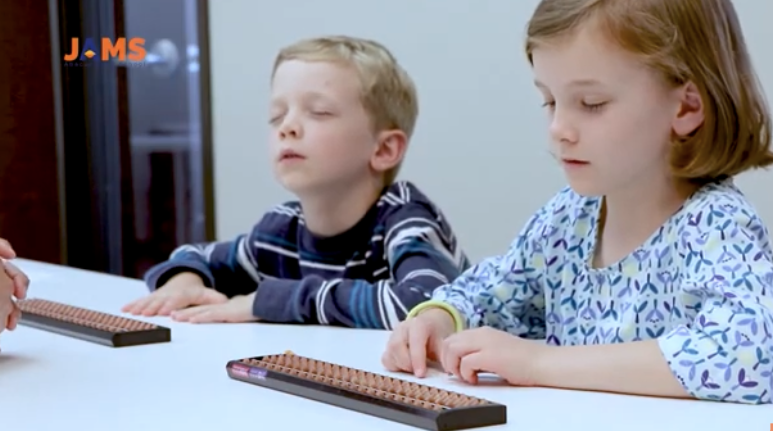
Why it matters now
Calculators, apps, and now AI can hand a child the answer in seconds. What they can't hand over is the ability to sit with a hard problem, make a mistake, try again, and solve it on their own.
That ability has to be trained. It's what we've been training at JAMS since 2001.
Abacus work rewards patience. Kids learn that a mistake is just the next thing to fix.

Seeing numbers on the abacus builds the number sense school math depends on.

Our 31 levels keep raising the bar, so strong students always have a next goal.
Our approach
Parents don't enroll their kids in martial arts so they'll become professional fighters. They want them to grow stronger, more disciplined, and more confident.
JAMS works the same way. The abacus is our training tool. Mathematics is the discipline. And like belts in a dojo, our 31 levels give every child a clear next goal, earned one step at a time.
"It's not about perfection. It's about excellence."
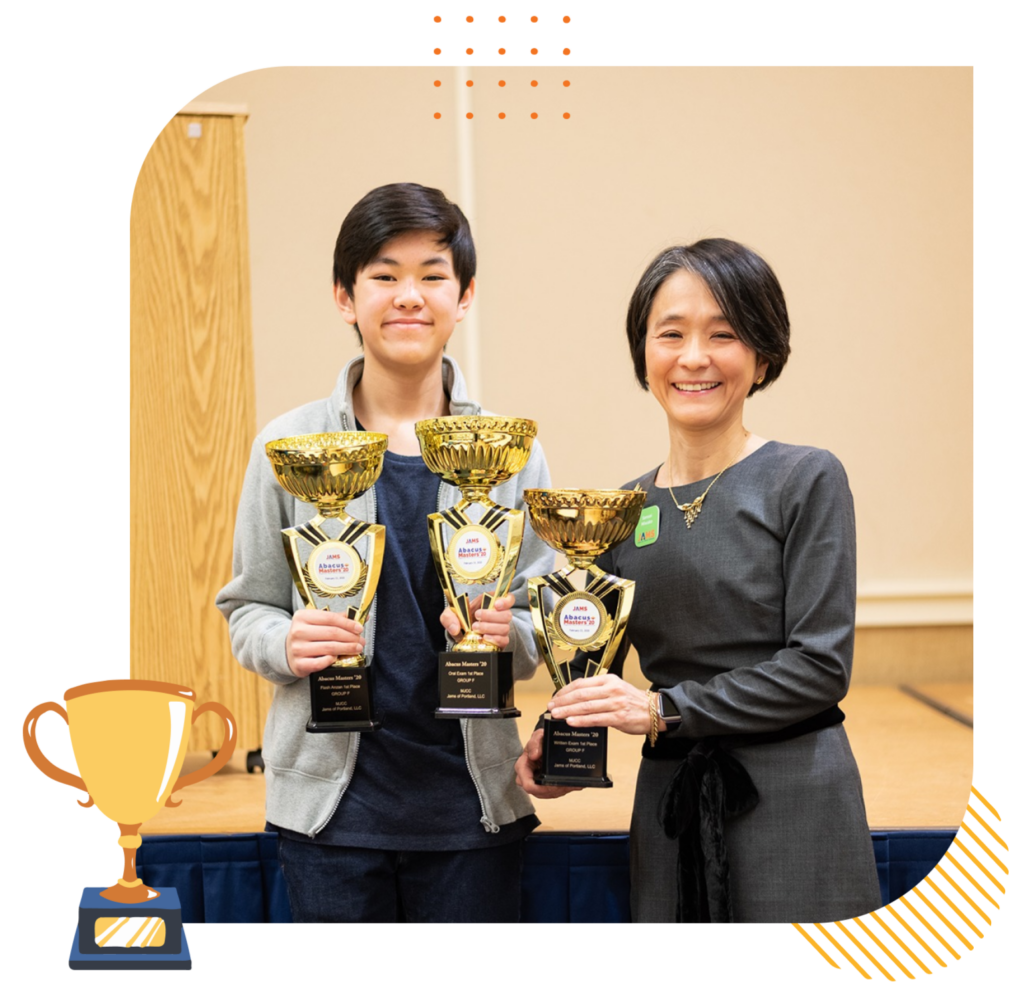
Meet our founder
Miwako Sakabayashi, known to our students as Miwako Sensei, first put her hand on an abacus at age 7 in Japan. At 12, she placed third in Japan's National Abacus Competition. As an adult, her abacus skills earned her a position in Japan's banking industry.
She moved to Oregon in 1992 and founded JAMS in 2001. In the 25 years since, she and her team have taught hundreds of Portland-area children. Her favorite moment hasn't changed: the look on a student's face when they discover what their own mind can do.
Meet Our TeachersGetting started

Step 1
Try JAMS for One Month, or enroll right away. There's no long-term contract.

Step 2
We'll help you choose your class times and place your child at the right level. The abacus, books, and materials are included with registration.

Step 3
Your child practices 10 to 15 minutes a day at home and moves up as they master each level.
Month-to-month means you're never locked in. Building lasting skill still takes time, and that's exactly why it lasts.
The JAMS path
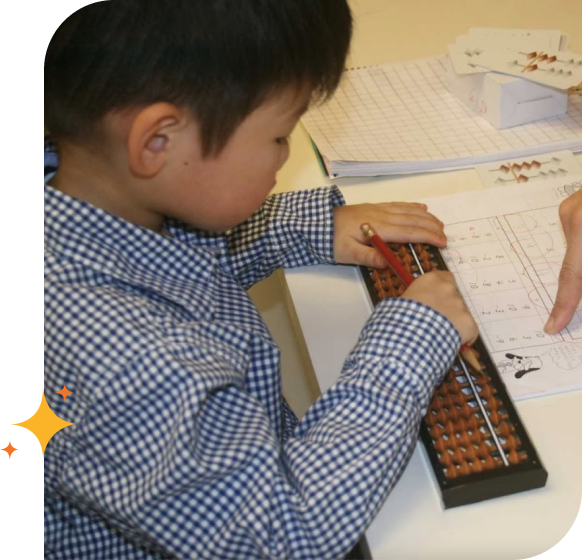
Students begin at Abacus Level 16 and work their way up, then continue into the Dan (master) ranks. Mental math training, called Anzan, builds alongside.
Stage 1
Abacus Levels 16 to 9
An introduction to the abacus and basic calculations that build the foundation.
Stage 2
Abacus Level 8
Multi-digit calculations and the first steps into mental math.
Stage 3
Abacus Levels 7 and 6
Mastering complex operations and building speed through steady practice.
Stage 4
Abacus Levels 5 and 4
Expert-level accuracy and speed, and readiness for competition.
Stage 5
Abacus Level 3 and up, including Dan ranks
The long climb toward mastery.
With daily practice at home and strong commitment, many students reach Anzan Level 3 in about 2 years. On average, it takes about 3 years.
But moving up fast is not the goal. Like a language learned in school and never used again, an unpracticed skill fades quickly. Soroban is a skill, and if you want your child to keep it for life, think in terms of 3 to 5 years or more. Our goal is for children to build the skill and learn how to practice, so it stays with them in school and in life.
At JAMS, we don't teach children to be perfect. Life is never perfect, and it challenges us every day. We guide children to excel.
It's not about perfection. It's about excellence.
Before and after
Aadrito joined JAMS at age five, shy and hesitant to try anything new. Years of steady practice later, he's a confident high school student who takes on hard problems with enthusiasm.
Kyle started at JAMS speaking only Japanese. He didn't let the language barrier slow him down. His journey from timid beginner to confident, high-achieving student shows what steady practice and the right guidance can do.
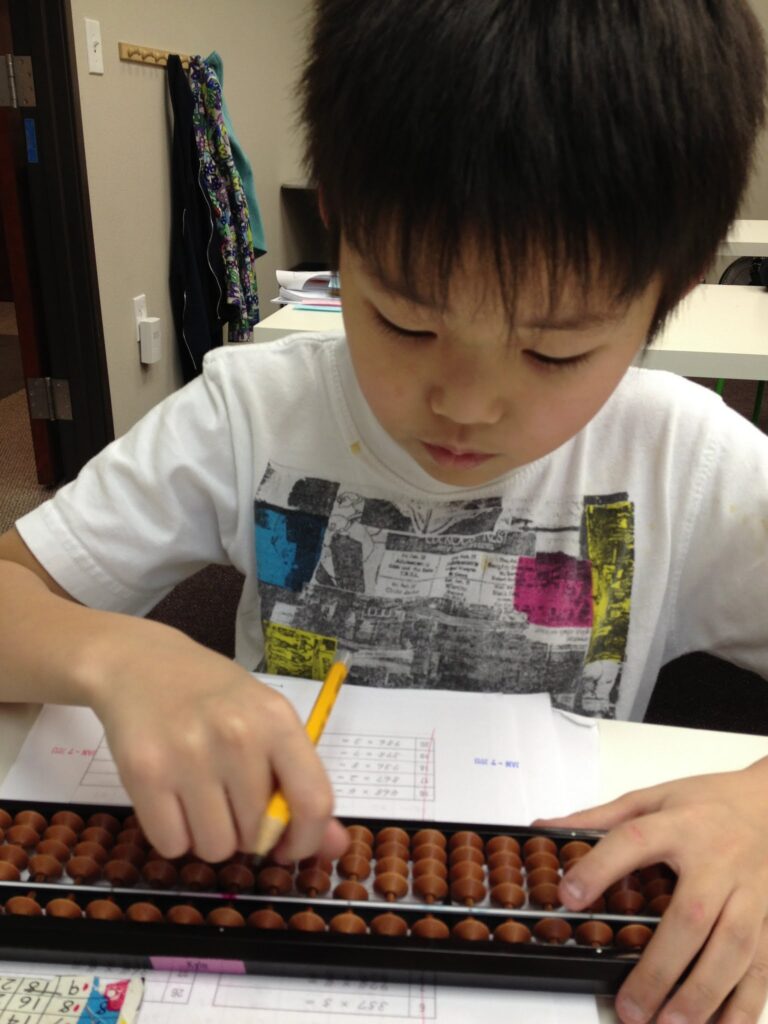
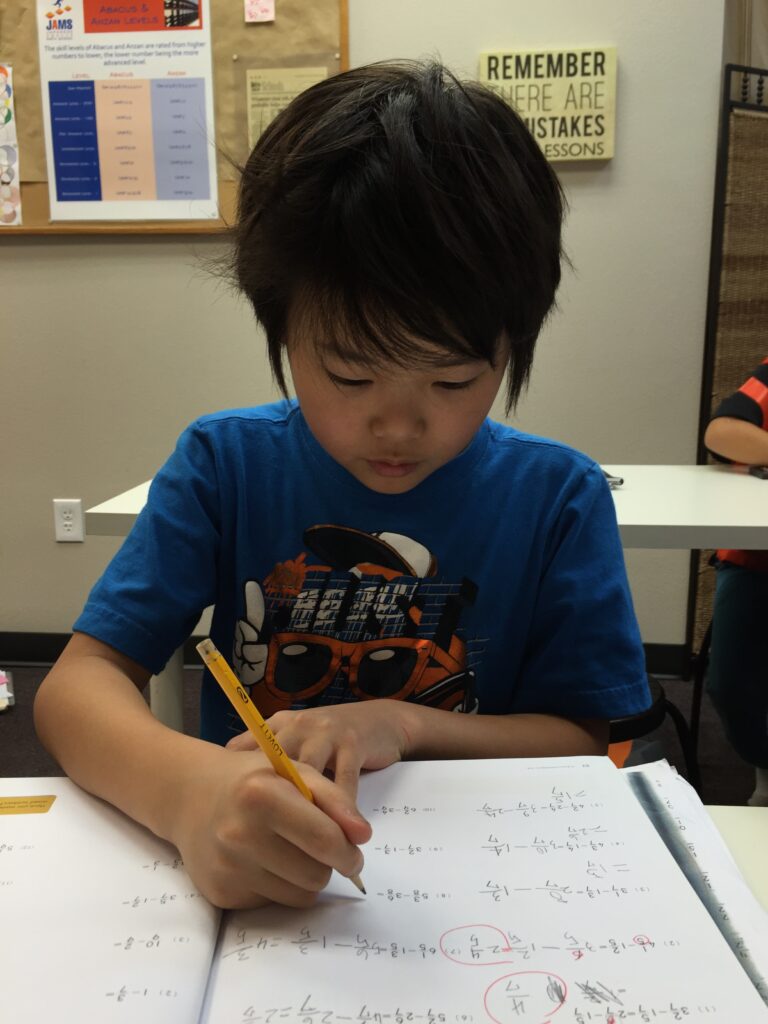
Winston discovered soroban at age 4, when he watched Sensei Miwako give an abacus demonstration at a neighborhood fair. He began lessons at JAMS at age 5, continued through 12th grade, and was competing at the national level by age 7. In June 2025, he graduated from Jesuit High School as valedictorian, and in fall 2025 he began his studies at Stanford University, where he is focusing on mathematics.
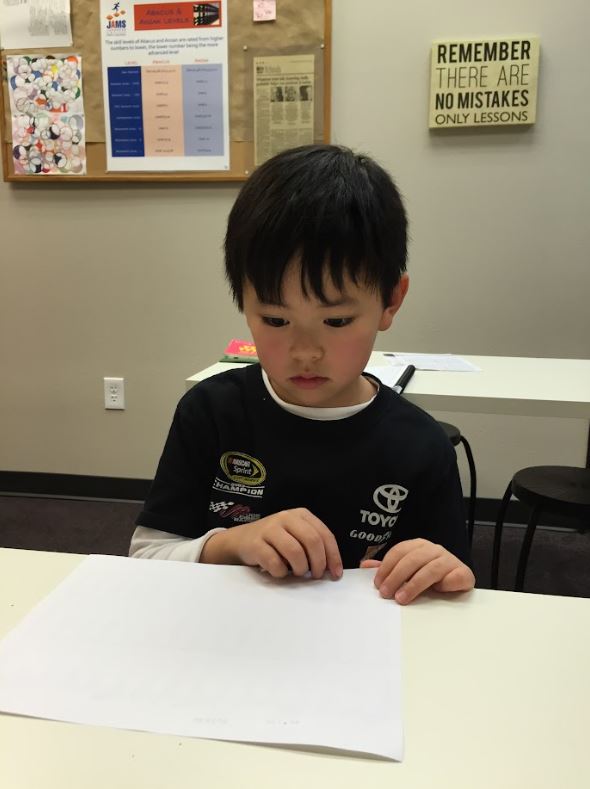

1 of 3
25th anniversary
For our 25th anniversary, JAMS alumni sent us video messages.
A partnership

 Our part Patient, expert teaching in a structured class A clear 31-level path with progress you can see Weekly attention to each student's progress Progress reports and parent-teacher meetings All core materials included with registration Your part Regular attendance 10 to 15 minutes of practice, 5 days a week A quiet place to practice at home Praise effort, not just speed Talk with us before you stop. Plateaus are normal, and we know how to help kids push through them.
Parent reviews
Lucas Xu 1 year ago on GoogleMy son attends JAMS and we saw a huge improvement in his math! The Senseis and staff there are all very nice and understanding. They are supportive of my son’s learning and encourage him to do his best!
Miranda Chung 1 year ago on GoogleSince my child went to JAMS, his calculation skills have improved a lot, especially the times tables. The teachers at JAMS always gave him encouragement and rewards, which motivated him to practice harder.
Adriana Camacho Ibanez 1 year ago on GoogleWe have been very impressed by the school’s quality and by the teachers’ expertise and dedication to their students. When we first joined, our daughter was struggling with some concepts that made math a difficult subject for her. Thanks to JAMS, her math skills, focus, and confidence in tackling problems have improved significantly.
Mani Pindiproli 1 year ago on GoogleMy daughter has been a part of JAMS for over a year, and I’ve noticed tremendous improvement in her calculation speed and overall confidence. Beyond academics, the program has helped her develop a strong sense of discipline, especially with homework. The teaching approach at JAMS is outstanding — enrolling my child here has truly been one of our best decisions.
Shu-Ching Chang 1 year ago on GoogleMy daughter has been with the JAMS program for over 7 years, and it has been an incredibly positive experience. The program is very well-structured, fostering not just a strong math foundation but also a love for learning and problem-solving. Sensei Miwako and the JAMS team are exceptionally caring and supportive, creating a nurturing environment that makes learning enjoyable.
pramod subramonium 1 year ago on GoogleWe have seen tremendous growth in our daughter’s math skills since joining JAMS. The involvement and nurturing environment from Sensei Miwako and her team is very supportive for her learning. Even her school weekly math homework is no longer a struggle — it’s approached with enthusiasm and independence.

Yes. Try JAMS for One Month: you pay the Registration Fee and the first month's tuition at enrollment, and JAMS doesn't set up automatic payments during that month. To continue, register in the Parent Portal. Families paying by ACH also complete the ACH authorization. If you don't continue, enrollment ends at the end of the month with no further charges.
There's no long-term contract. Tuition is due by the 15th for the following month, and tuition that has already been drafted is non-refundable. To stop, email us. If we receive your request by the 10th of the month, enrollment ends at the end of that month. Requests received after the 10th end at the end of the following month. Month-to-month makes it easy to start. Lasting skill still takes steady practice over many months.
Ages 4+. Anyone can join JAMS. Pre-K to 2nd grade is simply the ideal age to start, but students in 5th grade, 7th grade, and adults are all welcome. The best time to start is whenever someone wants to learn.
Kumon and similar programs focus on worksheets, repetition, and memorization, and often cover reading and writing too. Tutoring usually focuses on homework or test prep. JAMS focuses on training the mind through mental math. Students learn visually and hands-on with the abacus, then move to calculating in their heads. Along the way, they build focus, organization, and problem-solving habits.
Every child is different. With daily practice at home and strong commitment, many students reach Anzan Level 3 in about 2 years. On average, it takes about 3 years. But moving up fast isn't the goal. If you want your child to keep the skill for life, think in terms of 3 to 5 years or more.
There is no graduation at JAMS. Like martial arts, there's always a next level. But there is a milestone worth working toward: once a student passes Anzan Level 3, they've built a mental math skill that can stay with them for life.
JAMS is month-to-month, so getting started is easy. Try JAMS for One Month, or enroll today.
Questions? Call (503) 419-8040 or email info@jamsportland.com.